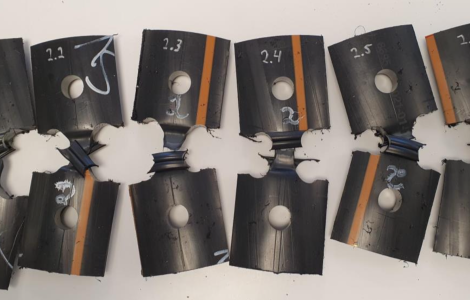
When pipes and structures made of thermoplastics are welded together, the quality of the joints is critical. In water and wastewater systems, aquaculture facilities, and industrial process plants, piping systems are expected to operate for decades—often under demanding conditions.

Therefore, strict requirements are placed on welding procedures, execution, and documentation. One of the methods used today is High-Force Fusion.
High-Force Fusion is a welding procedure for PE pipes (polyethylene) based on traditional butt fusion welding.
The principle is the same:
Preparation of pipe ends
The pipe ends are planed to ensure they are completely flat and clean. This is essential for the materials to fuse evenly.
Heating the material
A heating plate is placed between the pipe ends. When the plastic reaches the correct temperature, the surface material melts.
Joining the pipes
Once the heating plate is removed, the pipes are pressed together with high and controlled force. The molten material flows together, forming a homogeneous joint.
As the plastic cools, the result is, in practice, one continuous pipe.
“ The difference lies in how the welding process is controlled, particularly in terms of pressure, temperature, and timing parameters. Kristoffer Rønning, Bluegreen

High-Force Fusion is designed to make welding more efficient while maintaining the same quality level as other recognized welding procedures.
In practice, the method can contribute to:
shorter welding time per joint
more efficient project execution
consistent and repeatable quality
In projects with many welds, it is often possible to achieve up to approximately 30% faster welding, depending on dimensions, logistics, and project execution.
This makes the method particularly relevant for large infrastructure projects and long pipeline installations.

Modern welding equipment also enables the process to be run fully automatically.
This means that:
pressure, temperature, and time are controlled by the machine
operator influence is reduced
the risk of errors is minimized
This results in more predictable and consistent quality – especially important in projects with strict requirements for documentation and service life.
In modern projects, it is not enough for the weld to be performed correctly – it must also be documented.
The welding equipment records, among other things:
temperature
pressure
heating time
cooling time
The data is stored digitally, providing full traceability for each individual weld.
For many projects within water and wastewater, aquaculture, and industry, this is an essential part of quality assurance.

At Bluegreen, we work daily with welding of pipes and thermoplastic structures.
With our fleet of McElroy machines, our personnel can weld according to all recognized welding procedures and standards in the market—several dozen in total.
The machines can be operated fully automatically and provide reliable digital logging of welding parameters, ensuring that each weld is documented in accordance with project requirements.
Read more: McElroy fusion machines

Whether it is aquaculture facilities, water and wastewater systems, or industrial process plants, the quality of the piping systems is critical.
With the right expertise, the right welding process, and proper documentation, the foundation is laid for structures that will operate safely and reliably for many years to come.